Tony Takitani’s loneliness and bereavement
Blind Willow, Sleeping WomanTony Takitani’s loneliness and bereavement are not separate conditions: a life organized around solitude is briefly transformed by marriage, then altered again by his wife’s death. He had long treated being alone as a natural state, but loving his wife teaches him both the relief of companionship and the terror of its loss. After she dies, her clothing becomes a material trace of their shared life; as that trace disappears, his memory of her also recedes, leaving absence as the most durable part of grief.
Solitude Before Marriage
Tony’s habitual solitude begins in childhood. His father, Shozaburo Takitani, was often away with his band, and Tony grew accustomed to managing by himself: cooking, locking up the house, and sleeping alone. He had no close friends, but did not experience this as a painful deprivation. Being alone felt more comfortable than having someone attend to him, and he did not imagine that his life needed to change.
The distance between father and son was not simply indifference. Both were accustomed to solitude, and neither took the initiative to open his heart to the other. They saw each other only occasionally, often for business, and had little to say once it was concluded. Tony’s ordinary politeness and ease with acquaintances did not develop into intimate relationships. His settled expectation was that he would probably never marry.
That expectation made the arrival of love a rupture rather than a gradual adjustment. When Tony met the young woman who became his wife, the force of his response surprised him. Their early meetings were spent talking quietly for hours, sharing thoughts and backgrounds as though each were filling the other’s emptiness. When she needed time to decide whether to marry him, Tony found that his old solitary life had become newly visible to him—not as a comfortable premise, but as a prison.
Marriage and the Fear of Losing Her
During the days his future wife spent deciding, Tony could not work and drank alone. He understood, with despair, how much loneliness had accumulated in his life and how completely the possibility of her refusal had made him feel its weight. He told her directly how lonely he had been and how meeting her had made him recognize what he had lacked. She chose to marry him, and the marriage ended the solitary period of his life.
Companionship did not immediately bring uncomplicated security. On waking, Tony looked for his wife; finding her beside him relieved him, while not finding her made him anxious enough to search the house. The fact that he was no longer lonely itself frightened him, because it made him imagine becoming lonely again. For the first three months of the marriage, the possibility of losing the new happiness could provoke a physical spell of fear. Gradually he became accustomed to their shared life, and his alarm eased into a peaceful happiness.
The marriage therefore changed Tony without erasing his vulnerability. He had learned that intimacy could answer a need he had not previously recognized, but that discovery also made separation newly imaginable. His later bereavement would return him to solitude, though not to the earlier condition in which solitude had seemed sufficient.
The Death and the Clothes Left Behind
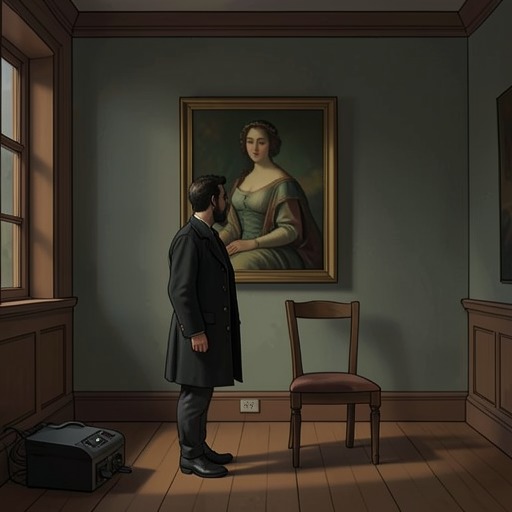
After his wife died, Tony was left with a room crowded by her clothing: dresses in size 7 and 112 pairs of shoes. He could not decide what to do with it all. He sold some accessories for the first price offered and disposed of stockings and underclothes, but left most of the dresses and shoes in place. After the funeral, he shut himself in the large walk-in closet and stared at the rows that occupied the room.
The clothes were more than possessions, yet their abundance could not restore the person who had worn them. Tony saw them as shadows his wife had left behind, arranged in layers that seemed to hold the many possibilities of a human life. He recognized that they had once moved with her and carried the signs of her presence; now they seemed detached from the life that had given them meaning. Their continued presence confronted him with loss rather than relieving it.
Ten days after the funeral, Tony advertised for a female assistant whose height, dress size, and shoe size matched his wife’s. He explained that she would do ordinary office work but would also wear his wife’s clothes, giving him time to get used to his wife’s absence. The request made the practical problem of the wardrobe into an attempted bridge between bereavement and daily life: another person would wear the garments, but could not make them belong to his wife again.
The Failed Attempt to Keep Grief Near
The prospective assistant chose dresses and shoes, then selected a light gray cashmere coat at Tony’s suggestion. After she left, Tony returned alone to the clothing room. He could not understand why she had cried at the sight of the garments. To him, they were shadows; as he looked at them, he felt their former connection to his wife and their present separation from her at once.
That recognition turned the clothing from a possible comfort into something he could no longer bear. Tony felt that the dresses had become meaningless remnants, and that their presence made his loneliness return. He called the woman and canceled the job, telling her to keep the clothes she had chosen and asking her not to speak about the arrangement. The attempt to place the garments back into everyday use ended as soon as he confronted what they represented: not his wife’s return, but her absence.
He eventually let a used-clothing dealer take everything she had left. The dealer paid less than a twentieth of the original cost, but the price did not matter; Tony wanted the clothes gone somewhere he would never see them again. He then left the room empty. Removal changed the room’s contents, not the fact of loss, and he continued to visit the bare space from time to time, sitting without any particular purpose and looking at its walls.
Memory and the Persistence of Absence
Over the months, Tony lost the ability to recall the clothing that had once filled the room. Its colors and smells faded, and even the vivid emotions associated with it withdrew from memory. The memories changed and grew fainter until they seemed like successive shadows. He could sometimes barely recall his wife’s face. What remained most tangible was not a clear image of her but the sense that she was gone.
One memory resisted this fading: the assistant, a stranger to the household, crying at the sight of his wife’s dresses. Tony could no longer remember her name, yet the image of her quiet grief returned. Its persistence complicates the gradual disappearance of the wardrobe from his mind. The stranger’s reaction had registered the emotional meaning of the clothes when Tony himself could not fully understand it; in later memory, her tears became an unexpected remaining link to the room and to his wife.
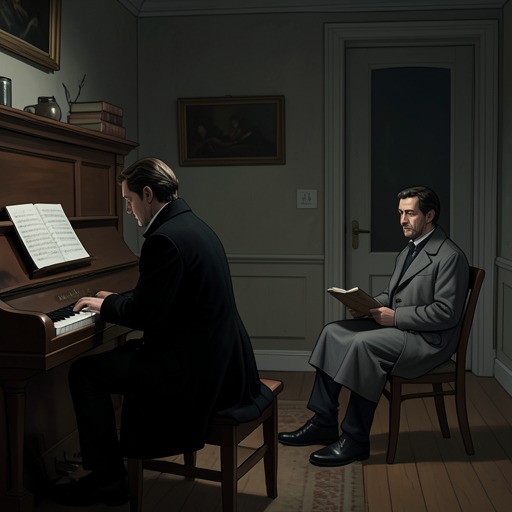
Two years after his wife’s death, Shozaburo Takitani died of liver cancer. Tony’s father left little property beyond some cash, stock certificates, his instrument, and a large collection of jazz records. Tony stacked the records in cartons in the empty room. Their musty smell required him to open the windows periodically, but otherwise he did not go in. The room that had once held the clothing of his dead wife now contained the records left by his dead father, while Tony’s relation to both forms of inheritance remained marked by distance and absence.
Tony’s bereavement does not resolve into the recovery of an intact past. The clothes can be removed, memories can fade, and the empty room can acquire another use, but none of these changes restores what has been lost. His experience shows how grief can outlast its most visible objects: as the material traces recede, absence remains, while memory preserves unexpected fragments rather than a complete portrait.